
Hoxie Criminal History Checks
A Hoxie search works best as a chain, not as one broad name query. First decide whether the event was a police call, an arrest, a filed court case, or a completed state criminal-history cycle. The official city directory is the local doorway, but it is not a case database. The Lawrence County Sheriff, Arkansas Judiciary, and Arkansas State Police each maintain a later part of the record.
Use these steps to keep similar names and separate events from being mixed:
- Contact Hoxie through its official directory and ask which agency holds the incident or arrest report.
- Give the report custodian the date, location, report type, involved name, and incident number if known.
- Check the Lawrence County jail roster when the Hoxie event led to a county booking.
- Search Search ARCourts for a filed district or circuit case, then ask the proper clerk for an official copy.
- Use ARCH through Arkansas State Police when the question calls for an Arkansas repository search rather than one local file.
There is no confirmed Hoxie police records portal or local case-search site. That makes the official contact chain more useful than an unofficial people finder.
Hoxie Directory Starts Report Requests
The Hoxie city directory is the official local source found for police and city-office contacts. It does not publish a records form, a fee list, or a searchable incident log. A requester should use the listed city contact to identify the custodian and ask how to submit the request. Do not assume that the city clerk, police contact, and court clerk hold the same material.
The official directory also shows the contact route that supports a Hoxie records request.
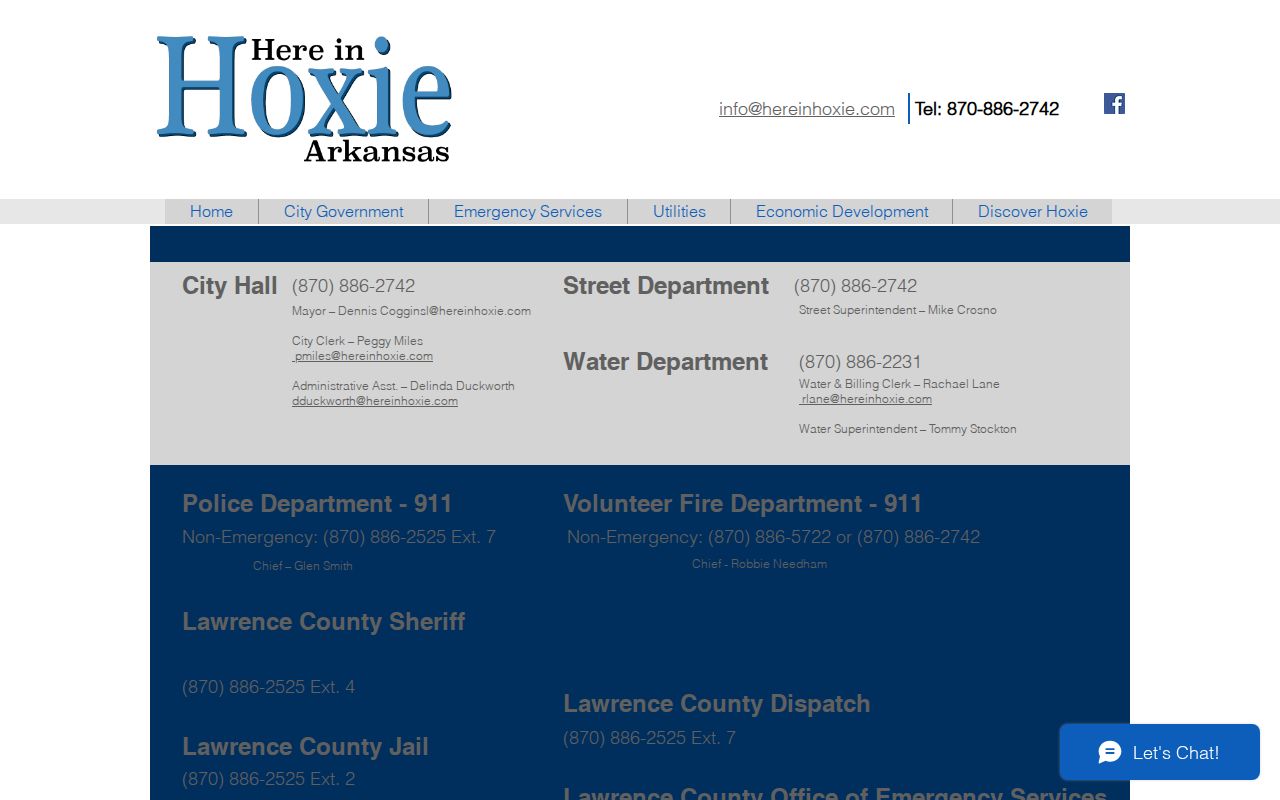
The directory image reinforces why the first task is locating the city custodian, not searching an unofficial database.
A useful request describes the event without asking for an undefined “full history.” Include the type of report, approximate date and time, location, names that may lawfully be used to find it, and an incident number when available. Ask whether the copy will contain redactions and whether a current charge has created a separate court file. Hoxie may withhold or redact material protected by law, including active-investigation details, juvenile data, victim information, and sensitive personal identifiers.
The official Hoxie site shows the city source behind this local route.
The city site confirms where a Hoxie inquiry should begin before the search moves to county records.
Records at the Hoxie Police Department
Hoxie police records concern what officers documented: an incident narrative, an arrest report, or related agency material. The research found no dedicated online request form, public blotter, or city police database. Contacting the department through the city directory is therefore the direct official channel. Ask which custodian accepts the request and what facts are needed to locate the report.
A police file is not the final court result. Officers may list suspected offenses and the facts known at the time, while a prosecutor later decides whether and how to file charges. A court can dismiss a count, accept a plea, enter a conviction, or record another outcome. Anyone reviewing their own Hoxie record should compare the police material with the docket and final disposition instead of treating the first report as the last word.
For an Arkansas State Police response, use the Arkansas State Police report channel rather than Hoxie. The agency that responded remains the key.
Hoxie Reports and Court Files Differ
The difference between a Hoxie police report and a court file can trip up a careful search. A city report records the agency's response. The court file begins after a charge is filed. It may contain a charging document, hearing entries, pleas, motions, orders, disposition, and sentence. Search ARCourts helps locate public case information, but its public screen is not an official court record.
When the online result matters, verify it with the clerk of the court that handled the Hoxie case. District court commonly handles lower-level criminal, traffic, and ordinance matters within its assigned jurisdiction. Circuit Court is the general-jurisdiction trial court and hears felonies. The Lawrence County Circuit Clerk is the route for official circuit files and certified copies. The district court contact handles its own record layer.
| Hoxie source | Best use | Limit |
|---|---|---|
| Police contact | Incident or arrest report | Not the final case outcome |
| Search ARCourts | Find a filed case | Public screen is not an official copy |
| Court clerk | Official file or certified copy | Must use the correct court |
Booking and Arrest Records in Hoxie
No official source identified a separate Hoxie city jail. When a Hoxie arrest leads to a county booking, the Lawrence County jail roster is the public current-custody route. The roster and the Hoxie police report have different purposes. One reflects jail intake and custody; the other reflects the city agency's event and investigation.
For a record that is missing online, contact the arresting agency for its report and the Sheriff's Office for booking or jail records. The roster is most useful for current custody and recent booking. It should not be read as a final finding of guilt. Charges shown at booking can be changed, declined, dismissed, or resolved under a different case description.
If a prosecutor filed a case, the lasting outcome belongs in the court record. The county-wide arrest search explains that booking chain in more depth. Hoxie readers can then use the city report, roster entry, and clerk file together without blending their roles.
Hoxie Cases in Search ARCourts
Search ARCourts is the online route for public Hoxie case information when a matter has been filed in an Arkansas court. Search by participant name, then narrow the result with case-search and advanced filters where the interface allows. A spelling difference, name variant, court assignment, or delay between filing and display can affect the result.
The result may show a case number, court, parties, charge or case description, events, and disposition information made public. It does not replace the clerk's official file. Use the case number to request a copy from the Lawrence County Circuit Clerk or the correct district court. That step matters when a screen is incomplete, an older item is absent, or the record is needed in official form.
A Hoxie incident may never become a filed case. No result can mean the prosecutor did not file, the search inputs do not match, access is restricted, or data has not appeared. It does not prove that no police report exists.
The Hoxie Municipal Court File
Hoxie lower-level matters belong in the district-court layer when that court has jurisdiction. The official research did not identify a separate Hoxie municipal case portal. Use Search ARCourts for public online case information and the Lawrence County District Court contact for local routing. Serious criminal filings move to Circuit Court.
| Court layer | District court for assigned lower-level, traffic, misdemeanor, ordinance, and preliminary matters; Circuit Court for felony filings. |
|---|---|
| Case lookup | Search ARCourts by participant and available case filters. |
| File contents | Case number, filed charge, docket events, pleas, orders, disposition, and sentence when public and applicable. |
| Official copies | Request from the clerk of the court that handled the case. |
| Copies and fees | No verified Hoxie or Lawrence County fee schedule was found; ask the clerk before ordering. |
Check the court name and case number before making a request. That small step keeps a Hoxie traffic or lower-level matter from being sent to the Circuit Clerk by mistake.
Hoxie Court Copies After Booking
A roster entry answers whether someone entered county custody. It cannot show the whole prosecution. After a Hoxie arrest becomes a filed case, the court file is the source for the charge selected by the prosecutor and the result entered by the judge. This shift from agency record to court record is why a name should be checked across sources in a sensible order.
Start with the docket to learn which court and case number apply. Then contact the correct clerk and state the exact document needed, such as a charging instrument, docket sheet, disposition, sentencing order, or certified copy. The Lawrence County Circuit Clerk is the official circuit-record contact. A district matter stays with the district court clerk.
No local court-copy fee schedule was confirmed. Ask about the current charge, copy format, certification, and delivery method. Do not publish or rely on a guessed fee. When a public screen and clerk file differ, the originating court is the right place to resolve the mismatch.
How Hoxie Records Reach the County
Hoxie records move through offices as an event changes. Police create the local report. A county jail booking creates custody data. A prosecutor may file a district or circuit case. Courts then enter pleas, orders, dispositions, and sentences. Fingerprints and reportable arrest and disposition data may flow to the state repository administered through Arkansas State Police and ACIC.
Record flow: Hoxie Police › Lawrence County Courts › Arkansas State Police / ACIC
Each step can update at a different time. ARCH is a repository product, Search ARCourts is a public case interface, and the jail roster reflects custody. None is a substitute for all the others. For a self-review, compare the record to the question: police facts from Hoxie, custody from the sheriff, court outcome from the clerk, and state-repository information from ARCH.
Disposition gaps can occur when data is delayed, not linked to the fingerprint cycle, sealed, corrected, or not yet reported. The clerk's final order helps when asking another official source to correct its display.
ARCH Is Not a Hoxie Report
Arkansas Criminal History Search, or ARCH, provides fee-based Arkansas repository searches through the state process. It is not the Hoxie Police Department's incident file, a complete county court file, or an FBI Identity History Summary. Repository results depend on arrest and disposition reporting from agencies and courts.
Use ARCH when an Arkansas repository check fits the purpose or when reviewing your own state record through the official process. Follow the portal's account and payment workflow. For fingerprint-based instructions, begin with Arkansas State Police criminal background checks. No official Lawrence County fingerprint service was confirmed in the research.
If ARCH shows an arrest without the Hoxie case outcome, confirm the final disposition with the clerk. A sealing order or corrected disposition may need to reach the agencies that maintain the displayed data. ARCH should add a state layer, not erase the need to verify a city or court source.
Hoxie Dismissals and Record Sealing
Arkansas commonly calls the remedy record sealing, though many people search for expungement. A dismissed Hoxie charge does not always vanish from every public source on its own. First find the case in Search ARCourts and confirm its final disposition with the proper clerk. Then determine whether the outcome and offense qualify under Arkansas sealing law.
The petition belongs in the court that handled the case. A Hoxie circuit criminal case routes to the Lawrence County Circuit Clerk; a district matter stays with that district court. Required notice to the prosecutor or agencies depends on the statute and court process. No Lawrence County-specific petition form or verified filing fee was found, so ask the clerk for current instructions rather than assuming a cost.
After an order is entered, check whether the court, Hoxie arresting agency, sheriff or jail, and state repository received it as required. Sealing limits ordinary public access. It does not mean every authorized government reference is physically erased.
Hoxie Record Access Rules
Hoxie city records are subject to Arkansas access law, but public access is not absolute. Open police material may be requested from its custodian. Active investigation details, juvenile material, victim or protected information, sealed files, and sensitive identifiers may be withheld or redacted. Court access also follows Arkansas Judiciary rules, and the clerk supplies the official record.
Key Statutes:
Arkansas Freedom of Information Act, Ark. Code Ann. § 25-19-101 et seq. gives the public a route to request government records subject to lawful exemptions.
Arkansas Supreme Court Administrative Order No. 19 governs public access and restrictions for court records.
Arkansas Comprehensive Criminal Record Sealing Act provides the statutory framework for restricting public access to eligible records.
Ask the custodian to explain any denial or redaction and identify the legal basis. A public-record request does not guarantee release of every page, but it does create a direct official path for Hoxie material that has no online form.